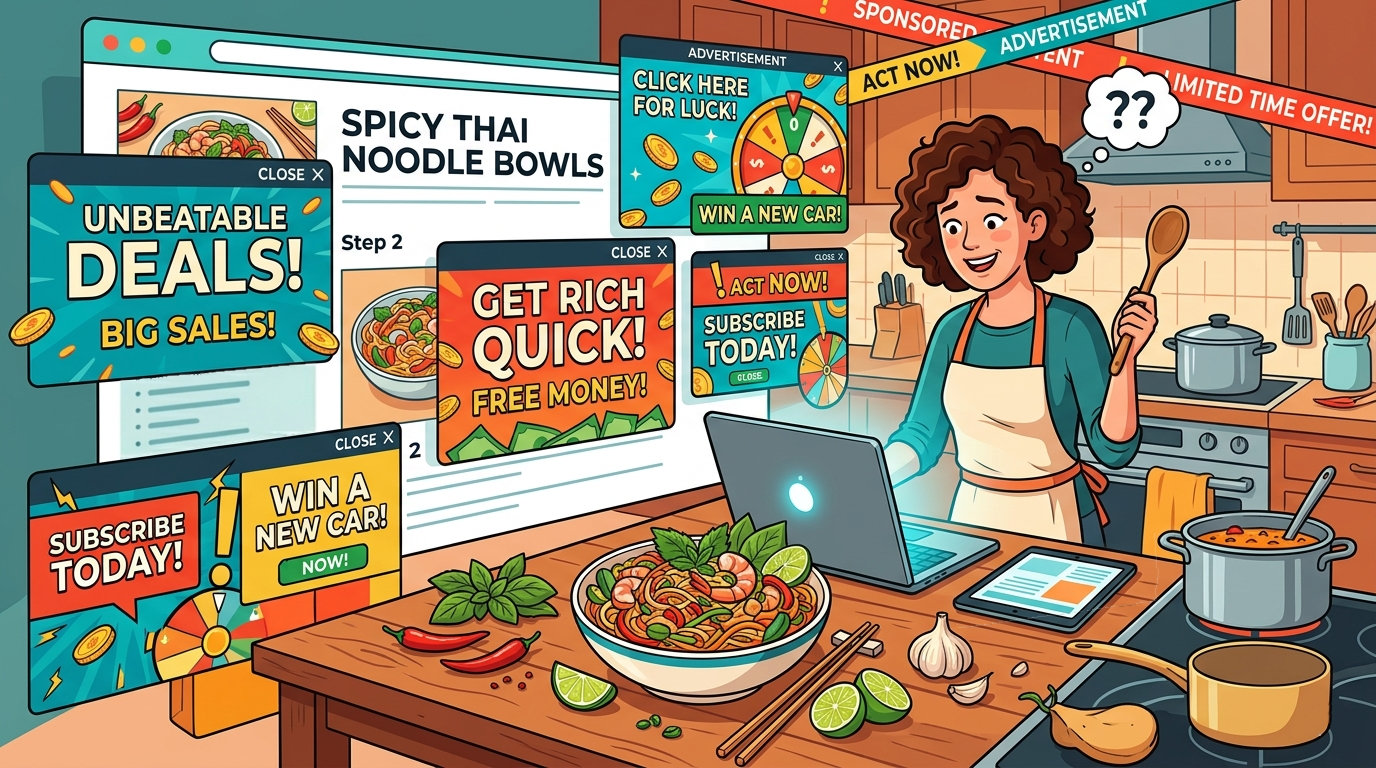
Why Recipe Sites Are Buried in Ads, and Why That’s a Choice
You searched for a pasta recipe. You got a six-paragraph memoir, two autoplay videos, a newsletter pop-up, and a cookie banner. By the time you reached the ingredients, you’d already given up and started scrolling past. This isn’t a bug. It was designed this way.
Recipe sites run ads because it’s easy money that scales without building something users would actually pay for. Every pop-up, autoplay video, and 1,500-word introduction exists to generate more ad revenue, not to help you cook. Sites that skip ads entirely have to earn their keep a different way. That changes everything about how the content is written.
Ads are the path of least resistance
Display advertising is the default monetization model for recipe sites because it requires almost nothing from the reader. You don’t have to offer anything worth paying for. You just need traffic and a contract with an ad network. Sign up with Mediavine or AdThrive, paste in a snippet of code, and the money starts coming in based on how many people visit and how far they scroll.
That’s a genuinely attractive setup. But it creates a site built entirely around extracting attention rather than being useful. The recipe, the thing you actually came for, becomes the carrot at the end of a very long stick.
Ad revenue is measured in RPM: revenue per thousand page views. The further down the page you scroll, the more ad impressions are served and the more money the site earns. Burying the recipe isn’t an oversight. It’s the business model working exactly as intended.
The long introduction exists because of money, not passion
The personal story before the recipe is often framed as authenticity, a way to connect with readers. That framing is mostly backwards. Long introductions exist because ad networks reward scroll depth, and because search engines historically ranked longer pages higher. Bloggers figured out that 1,000 words of surrounding content, regardless of quality, improved both ad revenue and search rankings.
The result is a genre of writing that has nothing to do with cooking. You are reading about someone’s grandmother’s kitchen in 1987 because it earns the site more money than putting the recipe at the top of the page would.
Pop-ups and autoplay video are the worst of it
Pop-ups that appear the moment a page loads, before you’ve read a single word, exist to grow email lists that get sold to sponsors. Cookie consent banners are legally required when a site runs ad tracking software across dozens of networks. Neither of these things improves your experience. Both of them exist because the site’s revenue depends on them.
Autoplay video is the most aggressive version of this. A single autoplay video ad can generate ten times the revenue of a static display ad. That’s why a recipe for roasted chicken loads with a video you didn’t ask for playing at full volume before the page has finished rendering. It is purely extractive, and everyone building these sites knows it.
These are deliberate product decisions, not accidents. The people running these sites are not unaware that pop-ups are annoying or that autoplay video is intrusive. They’ve made a calculation that the revenue outweighs the cost to the reader. You are on the wrong side of that calculation.
Why don’t they just charge for access instead?
Some do. Subscription recipe sites exist and some of them are excellent. But building something users will pay for is harder than running ads. It requires the content to be genuinely good, consistently useful, and trustworthy enough that someone hands over their card details. Ads require none of that. You can have mediocre content, a terrible user experience, and still earn a reasonable income as long as you have traffic.
For many sites, ads aren’t a temporary solution while they build something better. They are the product. The incentive structure never points toward improving the experience for readers because readers aren’t the customer. The ad network is.
What a recipe site without ads actually looks like
A site that doesn’t run ads has no financial reason to make pages longer than they need to be. There’s no revenue attached to your scroll position, no incentive to play video you didn’t ask for, and no email list to grow by interrupting you on arrival. The recipe can go at the top of the page because there’s nothing to gain by putting it at the bottom.
NoAdsCooking publishes recipes without ads, pop-ups, or long introductions. Every recipe goes straight to ingredients and steps. There is no tracking of how far you scroll, because there’s no ad revenue tied to it.
Common questions
Why do recipe sites make you scroll so far before showing the recipe?
Are recipe site ads actually that bad?
Is there a recipe site without ads?
Why don’t recipe sites just charge a subscription instead of running ads?
How do I find recipes without ads or pop-ups?
Recipes without the business model
NoAdsCooking publishes straightforward recipes with no ads, no pop-ups, and no scroll walls. The recipe is the page. That’s the whole point.
Recipes Without Ads