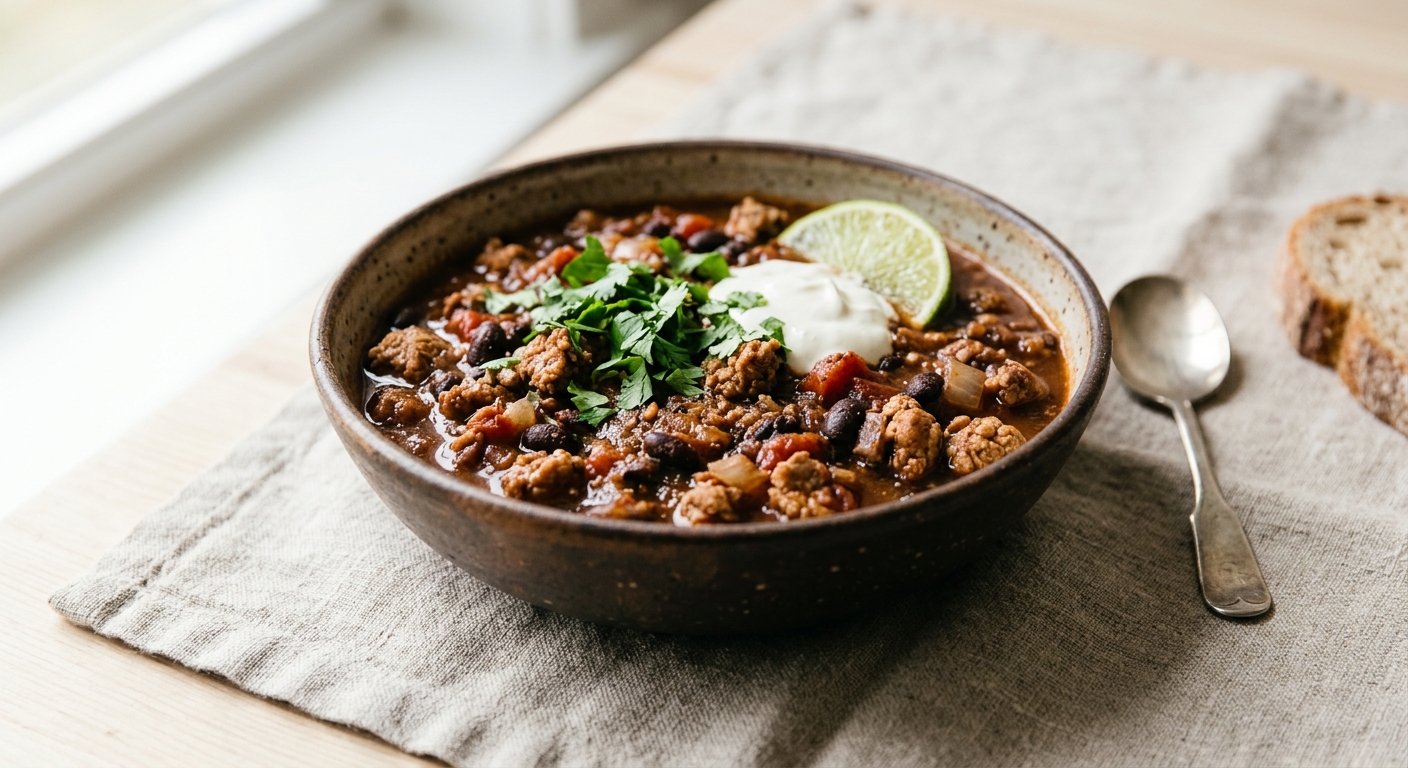
As the kitchen warms in late autumn, the perfume that rises from a simmering Dutch oven is often predictable: sharp cumin, roasted garlic, and the sweet tang of stewed tomatoes. Yet when a measure of pure, unsweetened dark cocoa powder hits the hot cooking fat, that familiar aroma transforms into something ancient, earthy, and profound. The sharp edges of dried chiles soften into velvet, while the kitchen fills with an intoxicating fragrance that feels both brand new and centuries old.
Chili has spent the better part of two centuries wandering through regional debates, cowboy lore, and cookoff rivalries. But the marriage of poultry, beans, and bitter cacao represents one of the most compelling evolutions in modern American cooking. It is a dish that honors ancient Mesoamerican gastronomy while solving the ultimate challenge of contemporary home cooking: how to coax profound, slow-simmered richness from lean proteins without simmering a pot for twelve hours.
This award-winning recipe unites lean ground turkey and creamy black beans with unsweetened dark cocoa powder. The cocoa’s natural tannins supply the savory depth and dark color typically missing in poultry chili, creating a complex, balanced stew that tastes like it simmered all day in just under an hour.
The Deep Chemistry of Dark Cocoa and Turkey: A Modern Mesoamerican Chili
From Sacred Aztec Vessels to the American Frontier
The culinary instinct to combine chocolate with chiles and beans is not a mid-century novelty; it is an inheritance that stretches back thousands of years to the Aztec empire. Long before cacao was processed with sugar and dairy into European confectionery, Mesoamerican cultures revered it as a bitter, sacred plant. Cacao seeds were fermented, roasted, and ground into a dark paste alongside dried chiles, wild herbs, and water, often served as a ceremonial drink or paired with regional staples of beans and maize. This ancient culinary philosophy recognized cacao for what it truly is: an intense botanical seasoning packed with bitter compounds, earthy fats, and complex aromatics.
When sixteenth-century Spanish conquistadors encountered cacao, they recognized its value but fundamentally altered its destiny. Transported across the Atlantic, cacao was sweetened with cane sugar, flavored with cinnamon and vanilla, and refashioned into an exclusive dessert luxury for European nobility. In the process, the original savory synthesis of chiles and cacao was largely left behind by Western cooking traditions for centuries, preserved primarily in regional Mexican moles and traditional indigenous kitchens.
The modern return of cacao to the savory pot emerged in the American Southwest during the mid-twentieth century. As competitive cooking circuits took hold across Texas, Ohio, and New Mexico in the 1960s and 1970s, serious chili cooks began looking beyond simple blends of ground beef and chili powder. Cooks in Texas red chili competitions and Cincinnati chili parlors quietly began introducing unsweetened dark cocoa powder to their spice mixtures. They found that cocoa provided a subtle bitterness and an impenetrable mahogany color that judges consistently rewarded, giving the stew an elusive foundation that competitors struggled to identify.
By the late twentieth century, American home kitchens began shifting toward leaner proteins and lighter weeknight meals. Ground turkey gained widespread popularity, but cooks quickly encountered a culinary dilemma: lean poultry lacks the heavy myoglobin, intramuscular fat, and natural collagen that give traditional beef chili its unctuous mouthfeel. In the 1990s and 2000s, forward-thinking competitive cooks bridged this gap by uniting turkey with dark cocoa and creamy black beans. The natural tannins in dark cocoa provided the structural richness that the lean turkey lacked, while the black beans contributed earthiness and body. This harmony turned turkey chili from a dutiful dietary compromise into an award-winning centerpiece in its own right.
The Culinary Science: Why Dark Cocoa Transforms Poultry
To understand why this recipe succeeds so brilliantly, one must examine the chemical interaction between cocoa, poultry, and dried spices. Unsweetened Dutch-process or natural dark cocoa contains polyphenols and tannins—the same astringent compounds found in aged red wine, black tea, and oak barrels. When turkey browns in a hot pot, it creates a modest foundation of Maillard reaction compounds. However, because ground turkey has a relatively neutral flavor profile and minimal fat, it can easily be overwhelmed by aggressive spices or taste thin and watery in a tomato-heavy broth.
Dark cocoa steps in as an architectural anchor. Its roasted bitterness counteracts the bright, acidic tang of canned tomatoes and tomato paste, balancing the palate in the same manner that a pinch of sugar balances a marinara, but without adding any cloying sweetness. Furthermore, cocoa contains lipid compounds and roasted pyrazines that blend seamlessly with ground cumin, Mexican oregano, and chili powder. When bloomed in oil alongside the aromatic vegetables, cocoa releases fat-soluble flavor compounds that coat the tongue, imparting a luxurious, velvety mouthfeel that mimics a slow-cooked bone broth.
The black beans provide the final textural component. As they simmer gently in the stew, their starches leach subtly into the broth, working in tandem with the cocoa particles to create a natural, glossy emulsion. The soft, creamy interior of the bean contrasts against the lean grain of the turkey, ensuring every spoonful offers both substance and comfort. Rather than tasting like chocolate, the finished chili simply tastes deep, resonant, and remarkably savory.
The Skill Tiers: Crafting Classic Chili at Home
In our recipe collection, dishes are categorized into skill tiers—Classic, Enhanced, and Chef’s Selection—to help home cooks navigate technique and preparation styles. The Hearty Turkey and Dark Cocoa Black Bean Chili is formulated as a Classic tier recipe, making it an accessible, weeknight-friendly centerpiece that does not sacrifice culinary integrity.
At the Classic level, the focus is on efficient execution and pantry-accessible ingredients without cutting culinary corners. You do not need to toast and rehydrate dried whole ancho and pasilla chiles, nor do you need to spend hours reducing a homemade poultry stock. Instead, the recipe relies on careful heat management and proper ingredient sequencing to extract maximum flavor:
- Browning the poultry: Rather than crowding the pan, the ground turkey is given time to develop a golden fond on the bottom of the pot, establishing essential browned meat flavors.
- Blooming the spices: Ground chiles, cumin, garlic, and dark cocoa powder are stirred directly into the rendered fat and aromatics before any liquid is introduced. This thirty-second bloom activates the spice oils and removes the raw, chalky edge of the cocoa.
- The controlled reduction: The chili is simmered uncovered for just long enough to let the tomato juices concentrate, allowing the starch from the black beans and the tannins of the cocoa to meld into a cohesive, velvety sauce.
While an Enhanced or Chef’s Selection interpretation might incorporate house-made bone broths, hand-ground toasted cacao nibs, or confit aromatics, the Classic tier proves that thoughtful kitchen technique applied to everyday ingredients can yield an extraordinary bowl of food.
The secret of dark cocoa in savory stews lies in its polyphenols: unsweetened cocoa mimics the savory depth of slow-braised beef by binding with poultry proteins and softening tomato acidity.
Serving Suggestions, Textures, and Next-Day Magic
A chili this structurally complex deserves intentional accompaniments that offer contrasting temperatures, textures, and acidity. Because the base is deep and savory, bright and crisp garnishes are ideal companions at the table:
- Quick-Pickled Red Onions: Thinly sliced red onions steeped in lime juice and sea salt offer a vibrant, sharp bite that cuts through the cocoa-infused broth.
- Cool Dairy: A dollop of full-fat sour cream, Mexican crema, or whole-milk Greek yogurt adds richness and tempers the lingering heat of the chiles.
- Fresh Textures: Diced Haas avocado brings silky fruit fat, while fresh cilantro and thinly sliced fresh jalapeños provide crisp botanical freshness.
- Warm Grains and Breads: Serve alongside warm stone-ground corn tortillas, crisp blue corn tortilla chips, or a cast-iron skillet of traditional buttermilk cornbread for dipping.
Like all great stews, this chili possesses remarkable staying power. While delicious straight from the pot on the evening it is cooked, it becomes noticeably more harmonious after an overnight rest in the refrigerator. During this chilling period, the cocoa’s tannins soften further, the black beans absorb the spiced broth, and the turkey thoroughly marinates in the sauce. If your schedule allows, consider making this dish twenty-four hours before you plan to serve it—your patience will be rewarded with a chili of unmatched sophistication.
Ready to Cook This Layered Classic?
See the full ingredient list and step-by-step method.
View the Full Recipe