
Few morning rituals match the understated luxury of thick slices of bread resting in a fragrant pool of egg and dairy, waiting for the hiss of a hot, buttered skillet. When the kitchen fills with the toasted aromas of caramelized milk solids, browned butter, and sweet warmth, the day instantly shifts into a gentler rhythm. French toast occupies a sacred space in breakfast repertoires precisely because it bridges thrift and decadence, taking what might otherwise be discarded and turning it into something worthy of a relaxed weekend feast.
Yet despite its ubiquity on diner menus and breakfast tables around the globe, truly exceptional French toast remains elusive. It is all too easy to stumble into common pitfalls: an undercooked, unpleasantly eggy center that borders on liquid batter; an exterior scorched before the custard coagulates; or a soggy, limp slice that disintegrates under the weight of a fork. Mastering the classic rendition requires an understanding of bread structure, emulsion, and heat transfer. When those elements align, the result is sublime: a delicate, bronzed crust giving way to an interior as tender and silky as baked bread pudding.
Great French toast hinges on three fundamental principles: choosing a sturdy, slightly dry bread that drinks up liquid without disintegrating; balancing whole eggs with dairy for a silky, rich custard rather than an omelet-like coating; and cooking slowly over moderate heat in foamy butter so the interior sets right as the exterior reaches a deep, caramelized amber.
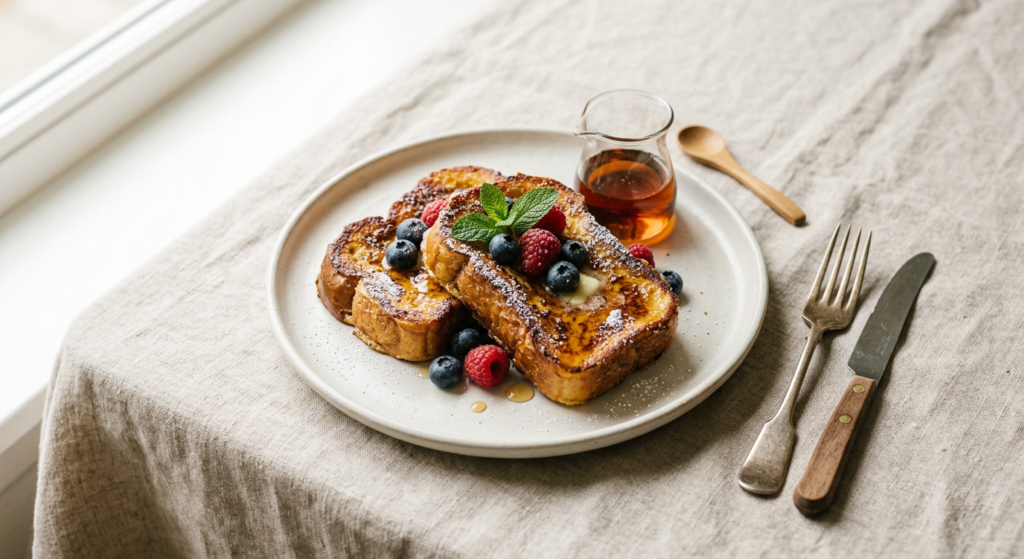
The Art of Classic French Toast: How Simple Custard and Stale Bread Create Morning Perfection
From Roman Sweets to Pain Perdu: A Dish Born of Thrift
The practice of reviving stale bread by soaking it in dairy and eggs long predates modern breakfast culture. While popular lore often attributes the dish to French culinary tradition, historians trace its earliest written documentation to ancient Rome. In the collection of recipes compiled during the late fourth or fifth century, traditionally attributed to Apicius, a dish termed aliter dulcia describes breaking fine white bread into crustless pieces, soaking them in milk and beaten eggs, frying them in oil, and dressing them with honey. To the Roman palate, this was not breakfast, but a luxurious sweet course enjoyed at the conclusion of an evening feast.
Throughout medieval Europe, variants of soaked and fried bread proliferated across borders and social strata. In German-speaking lands, it appeared in fourteenth-century manuscripts under the moniker arme ritter, or “poor knights,” a phrase echoed in England as “poor knights of Windsor.” The imagery was deliberate: it represented an inventive way for noble households experiencing reduced means to maintain an illusion of grandeur on the banquet table. Stale wheat bread, otherwise difficult to chew, was transformed through culinary ingenuity into a gilded confection dusted with precious spices like cinnamon and sugar.
In France, the dish earned its most enduring and descriptive name: pain perdu, literally “lost bread.” Here, the preparation was an ethical and economic necessity. Bread was the cornerstone of daily sustenance, imbued with profound cultural and religious significance; throwing away a stale loaf was considered nearly sinful. By saturating the hardened crumb with milk and egg, cooks reclaimed the “lost” loaf, creating a velvety dessert often finished with fruit compote or a splash of orange blossom water. As European immigrants carried these home traditions to North America, the name “French toast” gradually took hold in nineteenth-century cookbooks, cementing its status as an enduring morning staple.
Why This Recipe Works: The Science of Custard and Heat
The magic of French toast relies entirely on the interplay between starch structure and protein coagulation. When fresh bread is submerged into liquid, its tender crumb absorbs moisture rapidly and collapses, resulting in a fragile mush that tears when lifted. In contrast, stale bread has undergone starch retrogradation: its crystalline structure has reorganized and hardened, creating rigid capillary walls. These microscopic channels can draw in significant amounts of liquid while holding their shape intact, ensuring the slice maintains its architectural integrity through the dip and the skillet flip.
Custard balance is equally critical. An excess of egg whites creates an unyielding, rubbery matrix with a pronounced sulfur note when cooked, whereas an excess of cream or milk leaves the batter too thin to bind, resulting in a heavy, soggy slice. The classic ratio relies on whole eggs whisked thoroughly into milk or half-and-half, complemented by a modest pinch of sugar and a touch of salt. The sugar assists in surface caramelization through the Maillard reaction, while the salt enhances sweetness and moderates egginess. Whisking the batter thoroughly ensures the proteins are uniformly distributed, preventing patchy white streaks from clinging to the bread surface.
Finally, temperature management in the skillet dictates whether the toast is a triumph or a disappointment. Egg proteins set at relatively gentle temperatures—between 160°F and 175°F (71°C to 80°C). If the skillet is blistering hot, the exterior milk solids and butter burn long before the core reaches this coagulation point, leaving the center cool and raw. Conversely, a pan that is too cool will simply leach butter into the bread, producing greasy, pale toast. Cooking over steady medium-low to medium heat allows the butter to foam gently, frying the exterior to a crisp, golden crust while carrying heat inward to steam and set the velvety custard heart.
Navigating Skill Tiers: Building Morning Confidence
Cooking is a craft that grows with the cook, and breakfast dishes provide an ideal canvas for honing intuition. Within modern recipe design, skill tiers serve as a helpful roadmap for matching technique with ambition. A Level 1 Classic approach is all about foundational mastery: developing an eye for bread saturation, learning when butter is hot enough to receive the slice, and executing a clean flip without splashing batter.
As confidence builds, cooks often transition toward enhanced and advanced methods. Higher tiers might introduce richer enriched breads like brioche or challah that require delicate handling, overnight custards infused with whole spices and citrus peels, or hybrid cooking methods where the toast is pan-seared and then finished in a gentle oven to achieve uniform puff and soufflé-like loft. Yet every advanced preparation relies completely on the fundamental principles demonstrated in the classic tier: balanced hydration, patient temperature regulation, and high-quality staples.
A 20- to 30-second soak per side is the sweet spot for half-inch slices of artisan bread. Let the excess batter drain off for two seconds before placing the bread into the pan to ensure an even, crisp crust.
Technique Deep Dive: Bread, Pan, and Butter
Choosing your bread is the single most influential choice you make before turning on the burner. Standard sandwich bread, while convenient, lacks the structural backbone to absorb substantial custard. For the best outcome, choose a loaf with a dense yet open crumb, such as a traditional country white, a sturdy sourdough, challah, or day-old brioche. Slices should be cut generously—between three-quarters of an inch and one full inch thick. If your bread is freshly baked, you can simulate staling by arranging slices on a wire rack in a 300°F (150°C) oven for eight to ten minutes to dry the surface without browning it.
When it comes to the skillet, cast iron or heavy-gauge stainless steel offers the thermal mass needed to hold steady heat across multiple batches. Always begin with a mixture of unsalted butter and a touch of neutral oil; the oil slightly elevates the smoke point, preventing the butter solids from scorching prematurely. Swirl the pan until the butter foams and subsides just before laying in the soaked bread. If you are cooking for a crowd, keep cooked slices on a wire rack set inside a rimmed baking sheet in a 200°F (95°C) oven. This preserves the crisp exterior without trapping steam, ensuring every plate lands on the table warm and intact.
Finishing Touches and Serving Ideas
While French toast welcomes an array of creative garnishes, classic simplicity is difficult to surpass. A light dusting of confectioners’ sugar provides immediate visual appeal and delicate sweetness, while pure maple syrup—warmed gently in a small saucepan—penetrates the crust without chilling the plate. A pat of salted butter melting slowly across the top introduces an essential savory contrast to the sweet custard.
For those looking to expand the profile, fresh berries tossed with a teaspoon of lemon juice and granulated sugar offer a bright, acidic counterbalance to the richness of the bread. In autumn and winter, warm sliced apples or pears sautéed in brown butter with a pinch of nutmeg transform the dish into a cozy, seasonal centerpiece. No matter how you choose to garnish it, the hallmark of great French toast will always be that golden, crackling exterior protecting a cloud-soft interior.
Ready to Master Classic French Toast?
See the full ingredient list and step-by-step method.
View the Full Recipe