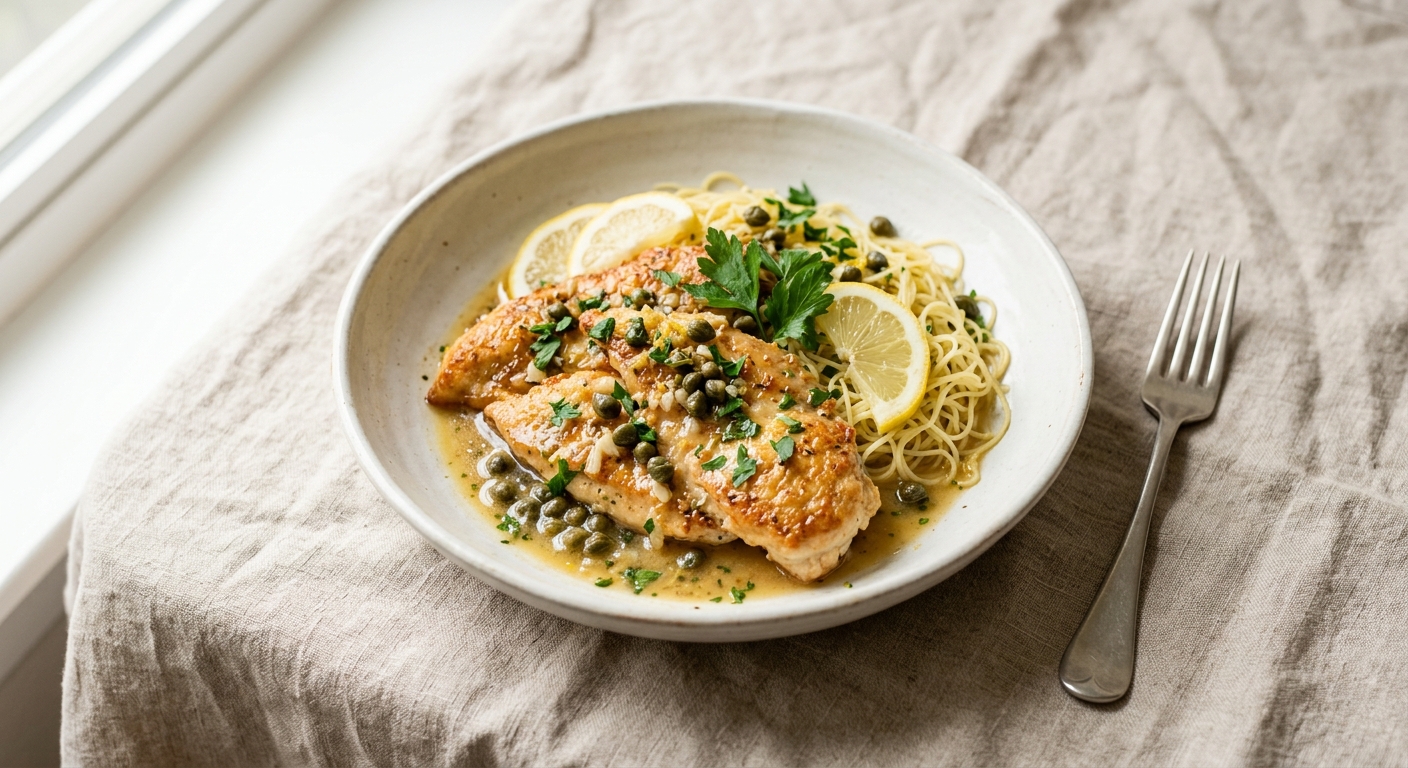
Chicken piccata frequently arrives at the dinner table as a soggy, sour compromise. A thick, gummy flour coating slides off limp poultry, swimming in a thin pool of sharp citrus and separated cooking oil. Cooks often drop whole, uneven chicken breasts straight into a scorching skillet, charring the narrow tail while the thick center remains stubborn, tough, and rubbery.
The dish succeeds when treated not as a blunt citrus bath for dry poultry, but as an agile exercise in rapid pan searing. Authentic chicken piccata is not an acidic wash over dry meat; it is a masterclass in fast pan cooking where uniform cutlets create a fond that emulsifies into a glossy lemon-butter sauce only when finished off the flame. When cutlet geometry is disciplined and pan heat is controlled, the resulting reduction becomes a cohesive glaze that clings to golden meat.
Lemon Butter Chicken Piccata: The Secrets to Tender Cutlets and Glossy Pan Sauce
From Veal in Milan to Chicken in Italian-American Kitchens
The origins of piccata trace back to northern Italian butcher counters, where the term historically described thin slices of meat pounded flat and cooked with sharp, piquant accents. In classical Milanese and Lombard kitchens, milk-fed veal cutlets served as the primary canvas for this brisk preparation. Cooks dusted delicate veal scallops in flour, browned them quickly in rendered lard or clarified butter, and finished them with squeezed lemon juice to slice through the rich animal fat.
When waves of Italian immigrants settled in eastern North American cities throughout the early twentieth century, culinary adaptations became necessary. Milk-fed veal was prohibitively expensive and difficult to source consistently in neighborhood butcher shops. American markets, however, offered an abundance of inexpensive, high-quality poultry, prompting home cooks and trattoria owners to substitute boneless chicken breasts without compromising the core flavor profile.
This migration transformed piccata from a luxury continental specialty into a cornerstone of Italian-American family cooking. Immigrant cooks retained the Mediterranean foundational elements of fresh flat-leaf parsley, cured capers, and citrus while adapting to the physical properties of poultry. The result was a faster, accessible skillet staple that honored northern Italian balance while meeting American weeknight demands.
It is worth noting what authentic chicken piccata is not. It is not an ancient Roman artifact, nor does it rely on heavy cream, garlic powders, or thick starch slurries. It is a modern immigrant triumph rooted in practical kitchen substitution, proving that disciplined pan technique can transform everyday poultry into a refined dinner in minutes.
The Purpose of Dredging, Wine, and Briny Capers
Every component in a classic piccata plays a direct mechanical role in flavor development and sauce cohesion. Dredging the chicken in all-purpose flour is frequently mistaken for an attempt to create a deep-fried crust. In truth, the flour coating should be a mere whisper, applied lightly and shaken thoroughly until almost invisible on the surface of the meat.
This thin starch barrier protects delicate surface proteins from harsh skillet heat, promoting even Maillard browning without scorching the flesh. Crucially, as the chicken sears, minute particles of toasted flour detach and settle into the rendered butter. These suspended starches provide the subtle body needed to bind oil and citrus later in the process, eliminating any need for cornstarch or heavy cream.
The deglazing liquid introduces vital depth that pure citrus cannot deliver on its own. Pouring a crisp, dry white wine—such as Pinot Grigio or Sauvignon Blanc—into the hot skillet rapidly dissolves the caramelized chicken fond adhering to the metal. The wine contributes rounded malic and tartaric acids, providing a complex aromatic spine that tempers the piercing bite of raw lemon juice.
Pickled capers complete the flavor trinity by providing concentrated bursts of salinity and herbal piquancy. Cured in salt or vinegar brine, these unopened flower buds cut straight through the richness of butterfat while echoing the floral notes of citrus. Lightly draining the capers prevents excess sodium from hijacking the delicate pan reduction, ensuring each bite offers a measured pop of savory contrast.
Pounding Cutlets and the Magic of Mounting Butter Off Heat
Whole boneless chicken breasts possess an uneven teardrop geometry that makes balanced pan cooking virtually impossible. The thick cranial end requires extended time on the burner to reach safe temperature, while the thin tail overcooks into dry, fibrous string. Pounding the meat flat between sheets of plastic wrap or parchment resets the thermal physics of the entire skillet.
Aiming for an exact, uniform thickness of one-half inch ensures that thermal energy travels through the meat at an identical rate across every square inch. A flat cutlet cooks through in four to five minutes per side, developing a golden crust before the interior moisture can evaporate. This uniform surface area also guarantees that the cutlet sits completely flush against the hot skillet floor, maximizing caramelized fond production.
Cooking fat requires careful management during the sear. Butter must be heated until its water content boils off and the remaining milk solids foam vigorously before the cutlets enter the pan. Placing the chicken into foaming fat seals the flour layer instantly, creating a clean release once browning occurs. Moving the meat prematurely strips away the delicate coating and ruins fond development.
The defining technical step of chicken piccata is the final emulsion, traditionally known in classical cooking as mounting with butter. If cold butter is tossed into a pan bubbling vigorously over an active flame, the dairy emulsion shatters instantly into clear grease and scorched solids. Pulling the skillet completely off the heat source cools the reduction below boiling, allowing the fat molecules in cold butter to suspend within the citrus and wine, producing an opaque, velvet glaze.
Why the Classic Version Needs No Complex Variations
Modern adaptations often crowd chicken piccata with heavy cream, sliced mushrooms, roasted garlic, or canned artichoke hearts. While palatable in other contexts, these additions muddle the sharp, clean clarity that defines the dish. Piccata is designed to be an agile, luminous dinner, where bright acidity and sweet butter share equal standing.
The single Classic tier of chicken piccata remains its strongest form because it demands pure focus on fundamental cooking habits. Without heavy sauces or melted cheeses to mask technical errors, the cook must pay strict attention to sear temperatures, deglazing timing, and pan agitation. This simplicity yields a plate that feels energetic rather than heavy.
Restricting the ingredient roster to poultry, butter, lemon, wine, and capers also guarantees lightning-fast execution on demanding weeknights. The entire cooking window takes less than fifteen minutes from the moment the meat hits the foaming pan to the final herb garnish. Preserving this brevity ensures that home cooks return to the dish regularly without feeling overwhelmed by multi-pot prep.
Pairing Crisp Cutlets with Starch and Bitter Greens
Because chicken piccata features an intensely flavored, acidic sauce, accompanying starches must act as neutral, absorbent anchors. Traditional buttered angel hair pasta or thin spaghetti provides the ideal vehicle, catching the glossy lemon reduction without demanding center stage. A gentle splash of starchy pasta cooking water folded into the noodles helps the lemon-butter emulsion coat every strand evenly.
Steamed long-grain rice or crisp roasted baby potatoes offer equally dependable foundations for diners seeking alternatives to pasta. The starch balances the sharp saline pop of the capers while soaking up any excess pan juices that run off the meat. Avoid heavily seasoned grains or dense risottos, which compete with the delicate nuances of the pan sauce.
Vegetables served alongside piccata should deliver texture and gentle bitterness rather than additional sweetness. Baby arugula tossed with a minimal drip of olive oil and sea salt offers peppery relief that resets the palate between bites of butter-coated cutlet. Sautéed rapini, charred broccolini, or steamed asparagus provide an earthy, green counterweight that prevents the rich pan emulsion from feeling monolithic.
Plate composition requires speed to prevent the thin cutlets from losing their crisp exterior. Transfer the browned chicken directly to warmed plates, then immediately spoon the glossy pan sauce directly over the meat and starch. Finish with a generous scatter of freshly chopped Italian flat-leaf parsley to introduce herbal aromatics and vibrant visual contrast.
Mastering the Fast Pan Sauce in Your Everyday Cooking
Learning the mechanics of chicken piccata provides far more than a single repeatable dinner; it establishes universal skillet competence. The four-part cadence practiced here—flattening lean meat, searing over foaming fat, deglazing caramelized fond, and mounting chilled butter off the flame—forms the foundation of classical pan cookery worldwide.
Authentic chicken piccata is not an acidic wash over dry meat; it is a masterclass in fast pan cooking where uniform cutlets create a fond that emulsifies into a glossy lemon-butter sauce only when finished off the flame. Once this structural principle is understood, the fear of separated sauces or rubbery weeknight chicken evaporates entirely.
These same physical concepts translate seamlessly to pork medallions, thinly sliced turkey escalopes, and delicate white fish filets. The skillet ceases to be an unpredictable heat source and becomes an instrument of precision. With a sharp knife, a heavy pan, and basic pantry staples, restaurant-quality dinners shift from an occasional weekend project into an intuitive, reliable weeknight reflex.
Ready to Cook Classic Lemon Butter Chicken Piccata?
See the full ingredient list and step-by-step method.
View the Classic Piccata Recipe