Science, history, and culture behind the common ingredient
The Pear
I remember my first bite of pear. I was little, maybe six. Someone picked one up off the ground and said, “You can eat it.”
I waited until my friend took the first bite. You don't need to be royalty to understand the poison cup test.
Eventually I bit into it, not knowing what to expect, and I wasn't a fan.
It tasted like an apple mixed with sawdust. All that grit, not the right kind of sweet, and the bees swarming around a yard full of fallen pears were not helping.
I didn't try another one for years.
Eventually came canned pears. Still no. Fruit cocktail? Somehow worse. For whatever reason, I could not get this right.
Then my palate changed. More importantly, I started eating with more curiosity and intention. I cooked more experimentally. From there, I started intuitively chaining flavors.
Somewhere along the way, the pear became one of my favorite flavors.
Do I regularly pick one up and eat it like an apple? Not really. I have, but knowing what else I can do with one almost makes that singular event feel like a waste.
That is what actually makes the pear interesting to me.
An apple seems perfectly happy being the entire point. Eat it raw, bake it into a pie, cook it with pork, turn it into cider. The apple always remains the star.
Pears have a different angle. Enhancement.
Give one nuts. Cheese. Warm spices. Grains. Pork. Pastry. Cream. Cognac. Purée it into a drink or cook it into a syrup. The pear has this remarkable ability to complement something else and make the entire concoction better without overwhelming it.
It can sweeten, soften, brighten, separate rich flavors, or bridge ingredients that otherwise might feel disconnected.
It might not be the undisputed champion of fruit, or even the obvious choice, but it has a pretty interesting role to play and a lot more reach than it gets credit for.
An apple seems perfectly happy being the entire point. Eat it raw, bake it into a pie, cook it with pork, turn it into cider. The apple always remains the star.
Pears have a different angle. Enhancement.
So What Exactly Is a Pear?
We recognize one immediately, but there is considerably more going on inside that familiar shape than its quiet reputation suggests.
What is with that distinctive grit? How sweet is it compared with other common fruits? Why do some pears seem to go from hard to perfect to ruined almost overnight? Which varieties behave differently when baked, poached, puréed, or eaten raw? Why has the pear, despite its enormous culinary versatility, remained so consistently overshadowed by the apple? Is it harder to cultivate?
To understand what the pear can do in a kitchen, we first need to understand the pear itself.
As it turns out, people have been working on this for a very long time.
Long before the modern supermarket, growers were already distinguishing pears by variety, use, and flavor.
Pears have been cultivated for thousands of years. They did not emerge from one tidy ancestral orchard. Western and Asian pears developed through separate centers of domestication across Eurasia, producing different fruit traditions long before the modern grocery store collapsed all of them into one small display.[1]
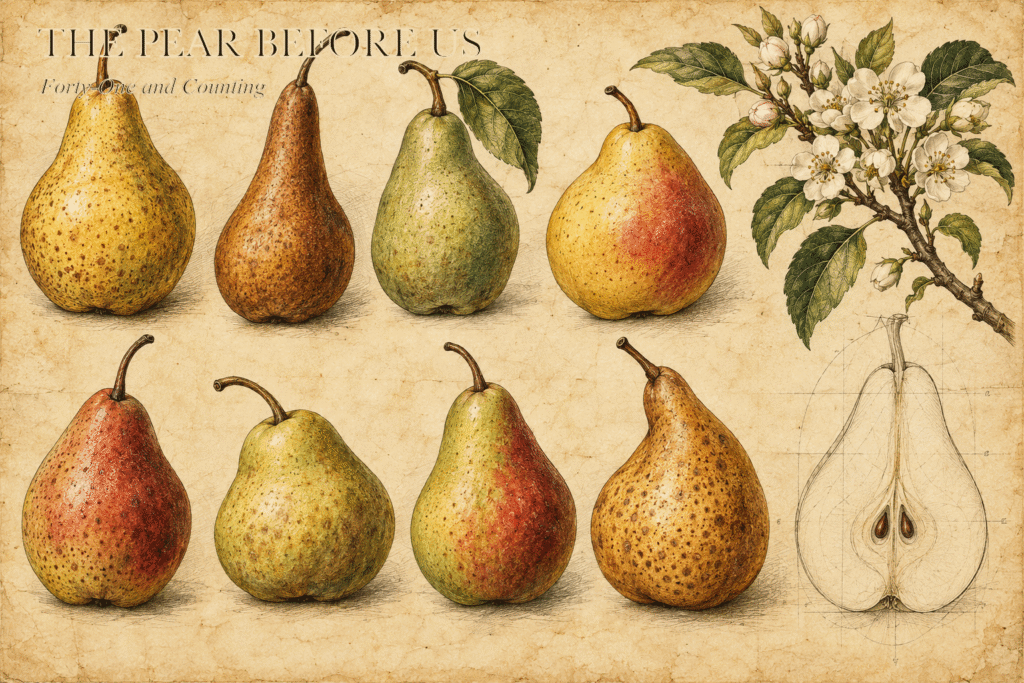
By the Roman period, this was hardly some obscure wild fruit. Pliny the Elder devoted an entire section of Natural History to pears and identified 41 varieties. Some were distinguished by where they grew. Others by flavor, appearance, or the drink made from their abundant juice.[2]
Pliny the Elder devoted an entire section of Natural History to pears and identified 41 distinct varieties in ancient Rome.
Forty-one varieties.
Ancient Rome had already reached the point where simply saying “pear” was not enough.
That early attention did not produce one perfect pear. It produced an enormous family of cultivars built for different purposes. Some are best eaten fresh. Some cook beautifully. Some store better. Others became perry, the pear equivalent of cider.
This is worth remembering when we stand in a grocery store looking at Bartlett, Bosc, and Anjou as though we are seeing the available range of pear technology.
We are not. We are seeing the varieties that survived a much more recent test: can they be grown, transported, displayed, and sold at scale?
Before the pear entered into broad region cultivation and global transportation, it was actually a royal project.
By the seventeenth century, fruit growing at Versailles was more than agriculture. It was prestige, experimentation, and spectacle.
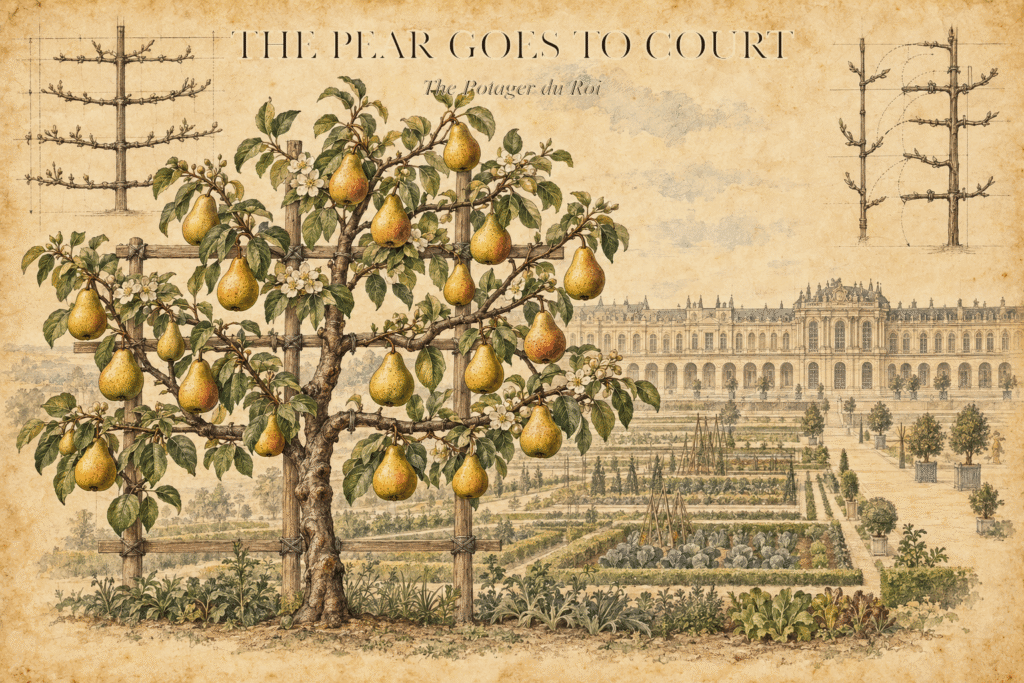
Louis XIV's Potager du Roi was created between 1678 and 1682 under Jean-Baptiste de La Quintinie. The garden used drainage, amended soil, walls, protected spaces, and manipulated microclimates to supply the royal table. La Quintinie managed lettuce in January, figs in February, strawberries in March, and melons in June.
Versailles' own history singles out pears among the fruits that attracted particular attention from La Quintinie and the king.[3]
The pear became royal fruit.
The garden also became known for intensive pruning and espalier, training fruit trees against walls and structures to control their growth and production (seen in the above image).
Somewhere between ancient wild fruit and produce bags, considerable royal money, land, and horticultural intelligence were spent figuring out how to grow a better one.
Eventually, the definition of “better” changed.
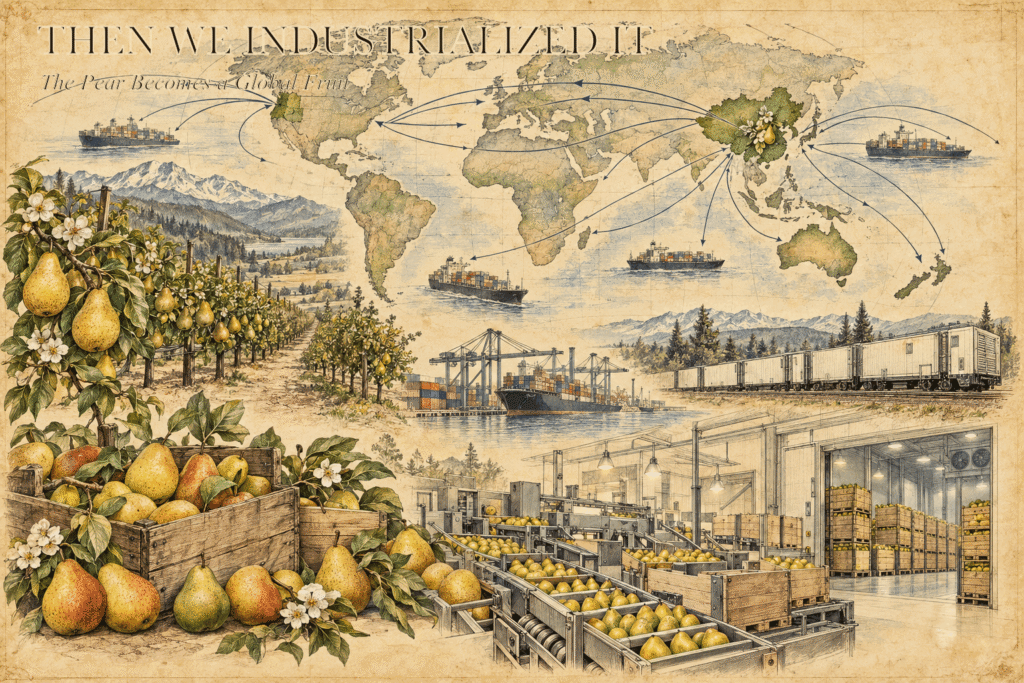
Today pears operate at a completely different scale. Royal preference has been replaced by acreage, yield, cold storage, shipping tolerance, appearance, and the narrow window in which a customer might actually want to eat one.
The USDA projects global fresh pear production at about 26.1 million metric tons for 2025/26 among the countries it tracks.
China accounts for about 20.5 million tons of that production.[4]
That is not a narrow lead. That is dominance.
The American industry is much smaller and heavily concentrated in the Pacific Northwest. Washington produced about 335,000 tons in 2025, with utilized production valued at about $141 million.[5]
There is another number in the Washington data that gets more interesting. About 305,000 tons went to the fresh market. Less than 30,000 went to processing.[5]
Growing pears, then, is not simply about producing edible fruit.
You need pears that can be picked, cooled, stored, shipped, handled, displayed, and taken home while still looking and behaving like something we want to eat.
Pears are not exactly cooperative to our preferences.
Many European pear varieties are harvested firm and finish ripening later. Some need extended cold storage before they will ripen normally. Oregon State notes that Comice pears need at least four weeks in cold storage before ripening, while D'Anjou can require even longer.[6]
The pear sitting on your counter is attached to a much larger set of strategic decisions. The inconvenient ripening behavior is simply part of the industry, and has quite a bit to do with what helped modernize and shape it.
The Pear Has Also Seen Some Things
For something with such a quiet reputation, pears have wandered into some strange places.
In October 2022, India's Directorate of Revenue Intelligence intercepted a shipping container arriving from South Africa. Its declared cargo was pears and green apples.
The fruit was real.
So were the 50.23 kilograms of cocaine authorities found concealed inside boxes of green apples. Officials valued it at more than ₹502 crore on the illicit market.[7]
To be fair to the pear, the cocaine was hidden in the apple boxes.
Always the bridesmaid.
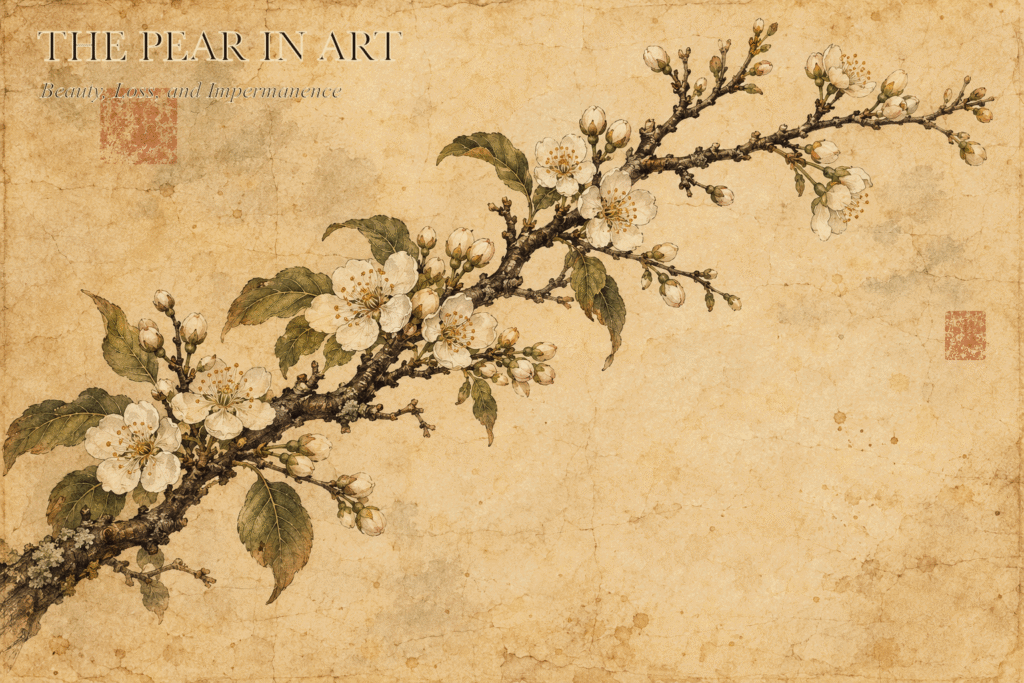
The pear has had a more respectable life in art.
A Chinese handscroll in the Metropolitan Museum of Art, Pear Blossoms, dates to around 1280 and follows the tradition of scholar-painter Qian Xuan. It combines painting, poetry, and calligraphy, using pear blossoms in a meditation filled with beauty and sadness.[8]
The pear has managed to be cultivated for thousands of years, cataloged by Romans, pampered by royalty, painted as an expression of human emotion, industrialized on a massive scale, and accidentally implicated in international cocaine trafficking.
Not bad.
But none of that explains the sawdust.
For that we need chemistry.
The Science of the Pear
First, How Sweet Is It?
We casually describe fruit as sweet or tart, but fruit producers and researchers actually measure part of this.
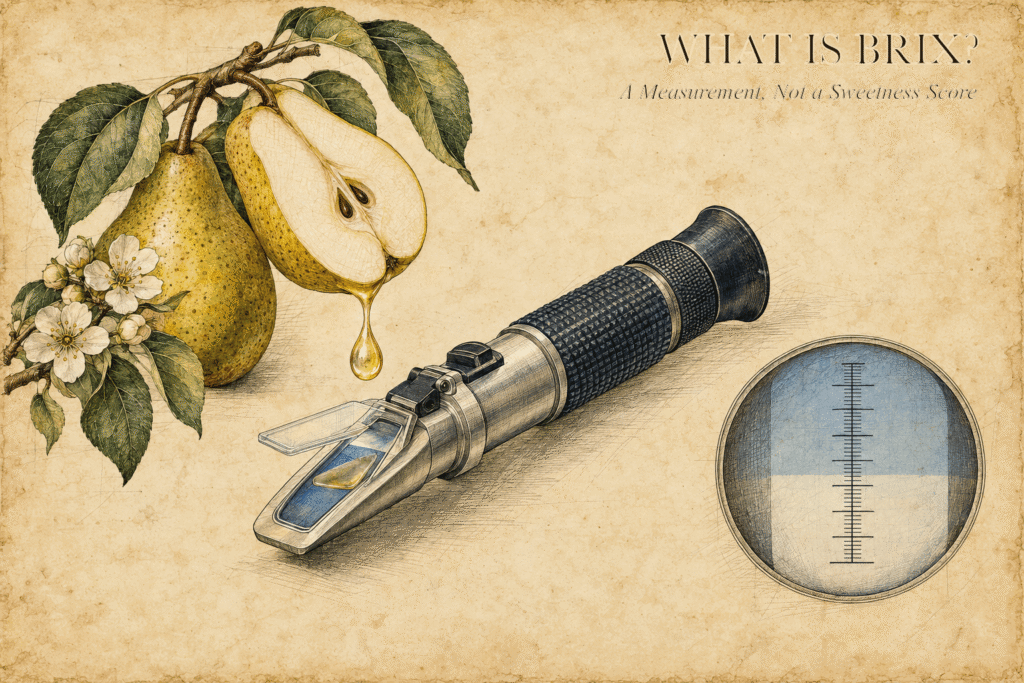
One of the most common measurements is Brix.
Degrees Brix, written °Bx, measure the concentration of soluble solids in a liquid.
With fruit juice, most of those dissolved solids are sugars, so Brix is commonly used as an estimate of sugar concentration.
A refractometer does the measuring. Put a little fruit juice on the instrument and it estimates soluble solids by measuring how light bends through the sample. In the simplified definition used for fruit testing, one degree Brix corresponds to about one gram of dissolved solids per 100 grams of solution.[9]
So a pear reading 13° Brix has a soluble-solids concentration of roughly 13 percent by mass.
Simple enough for some.
Except Brix is not a sweetness scoreboard like the Scoville Scale is for pepper heat.
Fruit juice contains more than sugar. Organic acids and other dissolved compounds contribute too. More importantly, our perception of sweetness depends on which sugars are present, how much acid accompanies them, aroma, temperature, texture, and ripeness.
Two fruits can produce similar Brix readings and not taste equally sweet.
Pears contain several major soluble sugars, including fructose, glucose, sucrose, and sorbitol.[10]
They also contain organic acids that contribute to flavor.
Brix gives us a useful number but our tastebuds have the final say.
Six year old me was not wrong about the texture.
There actually was something weird in there.
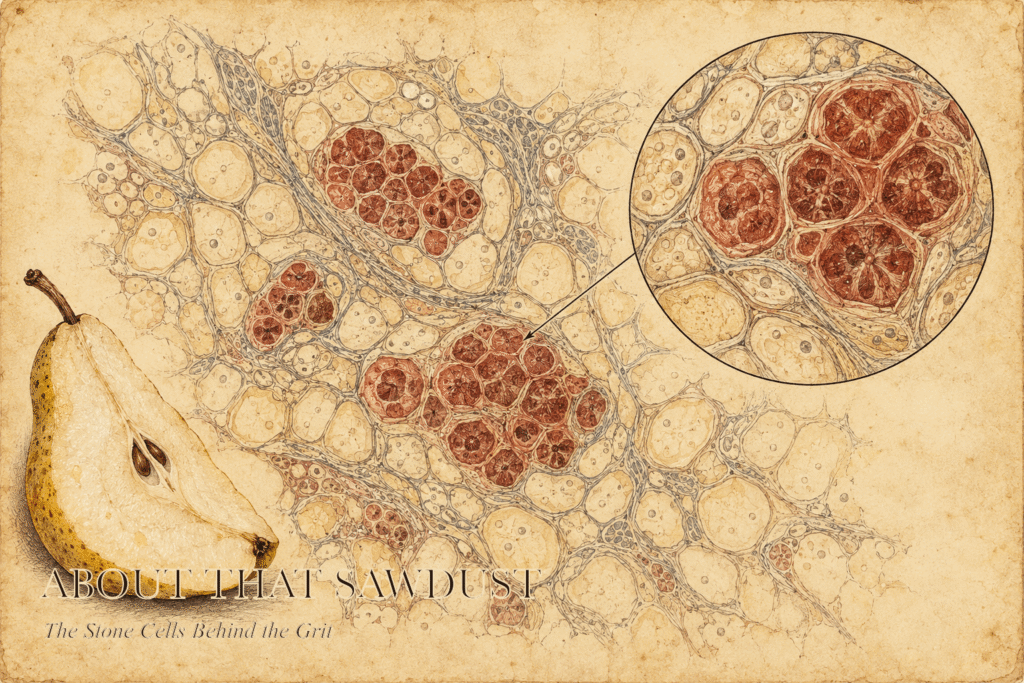
Pear flesh contains structures called stone cells, also known as sclereids. They are not foreign particles or some defect that wandered into the fruit. They are part of the pear's own tissue.
These cells develop thick secondary walls with substantial lignification. Gather enough of them together and they create the coarse, granular sensation associated with pear flesh.[10]
Your tongue physically detects them.
They are not distributed equally across every pear either. Genetics, variety, development, and growing conditions all influence stone-cell content. More stone cells generally mean a grittier texture.[10]
So “apple mixed with sawdust” was pretty spot on, and not entirely unfair.
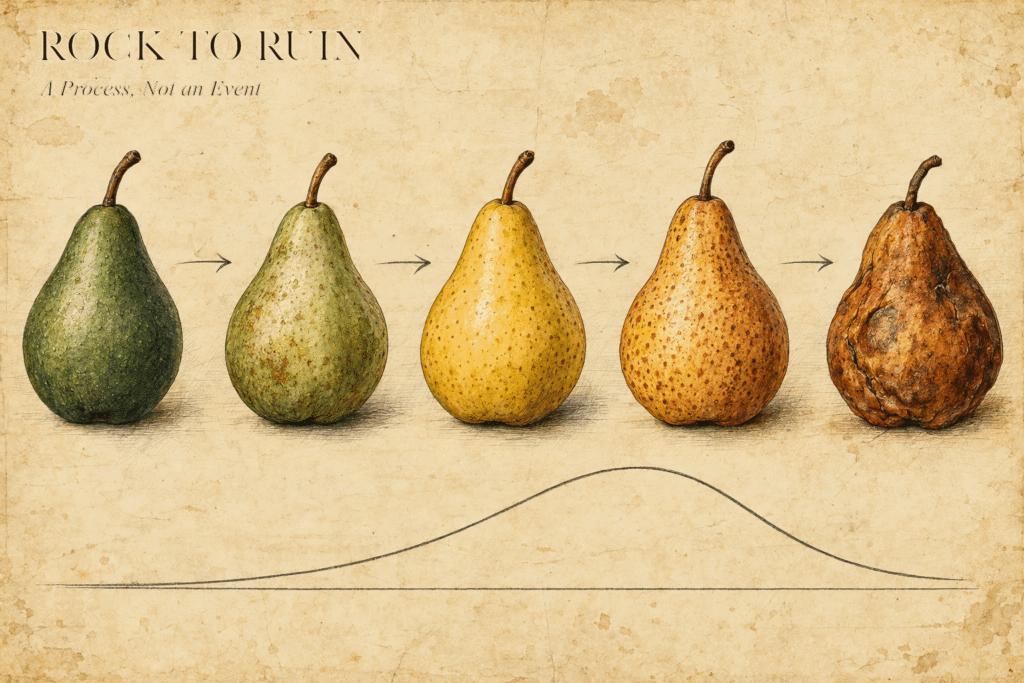
This might be the pear's most notable issue, and as the taste tester can feel a bit like random chance.
Many European pears are harvested firm and ripened after harvest.
Some require cold conditioning first.[6]
Then ethylene becomes part of the story.
Ethylene is a plant hormone involved in ripening. UC Davis notes that ethylene treatment can accelerate pear ripening and can even substitute for weeks of cold storage under commercial conditions.[11]
As the pear ripens, respiration and ethylene activity change. Its flesh softens. Its aroma develops. The balance among sweetness, acidity, texture, and volatile compounds changes with it.
And it keeps going.
Hard.
Hard.
Still hard.
Perfect.
How?
Timing.
The fruit has no particular interest in remaining perfect until Thursday because Thursday works better for your meal planning.
What Makes a Pear Smell Like a Pear?
Flavor is not just what your tongue detects. A huge portion of what we call flavor comes from aroma, and ripe pears produce a complicated collection of volatile compounds.
During ripening, the balance of those compounds changes.
Unripe pears tend to carry more of the “green” aroma associated with aldehydes and alcohols. As the fruit matures, esters become more prominent. Those esters contribute much of the sweet, fruity aroma we recognize as ripe pear.[12]
This helps explain something anyone who keeps pears on a counter has probably noticed.
For days, almost nothing.
Then suddenly you can smell the pear from across the kitchen.
This is part of ripening. Because smell is such a large part of flavor, that aromatic change is part of the reason the same pear can seem like it will never be ready and then one day suddenly seem like a pear scented candle has been lit.
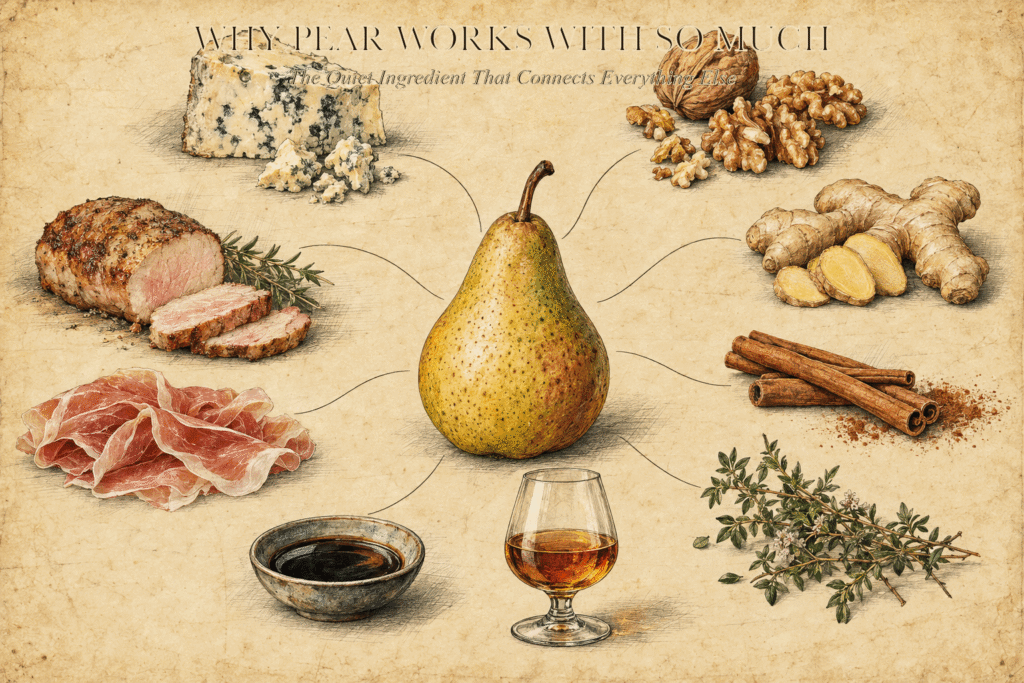
There is no molecule inside a pear looking for goat cheese.
Food pairing is more complicated than ingredients either chemically matching or not matching. The chemistry can help describe what we smell and taste but falls short of offering certainty that dinner will be good.
What we experience as a successful combination usually comes from some mix of aroma, contrast, texture, sweetness, acidity, fat, salt, bitterness, and expectation.
Pear happens to be useful across a lot of those dimensions.
Its flavor can be sweet and aromatic without being aggressive. Its texture can move from crisp to soft depending on variety and preparation. Many common dessert pears also leave room for sharper, saltier, richer ingredients around them.
That gives us options.
Pear and blue cheese use contrast. Sweet against salty and funky.
Pear and walnuts or pecans add fat, toast, and crunch against soft fruit.
Pear and pork use sweetness and fruit aroma against richness.
Pear and balsamic bring additional acid and concentration.
Pear and cream let fats absorb the aromas while softening or taming everything else.
Then we have our spices.
Cinnamon works beautifully with pear, but pear does not stop there.
Ginger adds sharpness and heat.
Cardamom adds floral and resinous aroma.
Clove brings intense and pronounced.
Vanilla reinforces our perception of sweetness without requiring more sugar.
Black pepper can also work and offer modest heat.
Apples can work with all of these too. This is not some exclusive chemical relationship available only to pears.
The difference, at least to me, is how seamlessly pear can cooperate with them.
That brings us back to enhancement. An ingredient does not need to dominate a dish to have an enormous effect on it. Sometimes its job is connecting to other things.
Pear can bridge cheese and nuts. Pork and spice. Cream and Cognac. Bitter greens and balsamic. Grain and herbs.
It can be the reason everything has elevated taste.
So, the Pear
I started this wanting to know why I had spent so much of my life misunderstanding a fruit.
Some of it was apparently bad timing.
Some was stone cells.
Some was probably a terrible canned pear.
But the more interesting answer is that I was expecting the pear to behave like an apple when it doesn't.
Its history spans ancient cultivation, Roman agriculture, royal gardens, and modern global trade. Its strange texture comes from hardened cells we can literally feel with our tongues. Its sweetness can be measured, but the number does not fully explain how sweet it tastes. Its aroma develops as it ripens. Even that frustrating little window in which a pear seems perfect is biology doing exactly what it is supposed to do.
In the kitchen, all of those characteristics give it range.
So maybe the pear is always the bridesmaid, that's cool.
But don't take my word for it. While researching this article, I found an 1864 essay already framing the pear in relation to its firmer relative, the apple, and calling it the apple's “modest rival.”[13]
Apparently I'm not alone in the second-class fruit citizen observation.
The apple still gets the pie, the cider, the orchard mythology, and most of the seasonal attention.
The pear is usually somewhere nearby.
Turns out the ingredient standing beside everything else and making it work might deserve a little more attention of its own.
Meaning we use the fruit according to its strengths. Give it salt. Give it acid. Give it toasted nuts, browned meat, pastry, cream, spice, or a pour of Cognac. Let it connect the things around it.
Now that we know what we are dealing with, we should cook something.
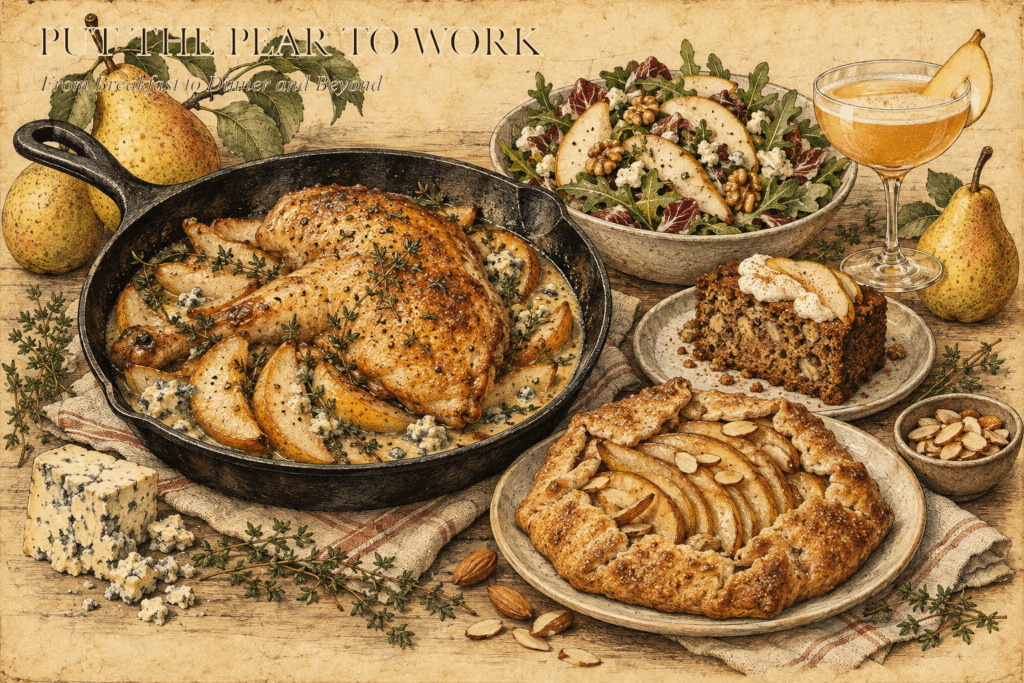
Put the pear to work, from a savory chicken dinner to salad, pastry, cake, and cocktails.
Featured Dinner
Pan-Roasted Chicken Quarters with Pear and Blue Cheese Pan Sauce — Bone-in chicken quarters are browned in a skillet and finished with sliced pear, shallot, thyme, stock, and blue cheese. Chicken supplies the weight. Blue cheese brings salt and funk. Pear gives the sauce sweetness, aroma, and keeps the stronger flavors from piling on top of one another.
More Pear Recipes:
- Pear Balsamic Salad with Goat Cheese, Candied Pecans and Arugula
- Maple-Pecan French Toast with Roasted Pears
- Pear-Ginger Baked Oatmeal with Toasted Walnuts
- Spiced Pear Molasses Cake
- Pear Almond Galette
- Pear Cognac Sour
These recipes let the pear take several different jobs. It can brighten bitter greens, soften blue cheese, disappear into a cake, carry ginger through a bowl of oats, or lend fruit and aroma to a drink.
Sources and Further Reading
[1] Pear domestication and genetic history — Wu, J. et al. “The Genome of the Pear.” Genome Research. https://pmc.ncbi.nlm.nih.gov/articles/PMC5423897
[2] Pears in ancient Rome — Pliny the Elder. Natural History, Book XV, Chapter 16, “Forty-One Varieties of the Pear.” Perseus Digital Library. https://www.perseus.tufts.edu/hopper/text?doc=Plin.+Nat.+15.16
[3] Pear cultivation at Versailles — City of Versailles. “Curiosités botaniques.” https://www.versailles.fr/220/decouvrir-versailles/histoire-de-versailles/curiosites-botaniques.htm
[4] Global pear production and trade — U.S. Department of Agriculture, Foreign Agricultural Service. Fresh Apples, Grapes, and Pears: World Markets and Trade, December 2025. https://apps.fas.usda.gov/psdonline/circulars/fruit.pdf
[5] Washington pear production and economics — USDA National Agricultural Statistics Service. “2025 State Agriculture Overview: Washington.” https://www.nass.usda.gov/Quick_Stats/Ag_Overview/stateOverview.php?state=Washington&year=2025
[6] Harvest, cold conditioning, storage, and ripening — Oregon State University Extension. “Picking and Storing Apples and Pears.” https://extension.oregonstate.edu/catalog/fs-147-picking-storing-apples-pears
[7] The pear shipment involved in a cocaine seizure — Government of India, Press Information Bureau. “Directorate of Revenue Intelligence Seizes Smuggled Cocaine Worth Over ₹502 Crore,” October 8, 2022. https://www.pib.gov.in/PressReleaseIframePage.aspx?PRID=1866030
[8] Pear blossoms in art — The Metropolitan Museum of Art. Pear Blossoms, after Qian Xuan, ca. 1280. https://www.metmuseum.org/art/collection/search/40309
[9] What Brix measures — Penn State Extension. “2026 Pennsylvania Tree Fruit Maturity Report.” https://extension.psu.edu/2026-pennsylvania-tree-fruit-maturity-report-august-3
[10] Pear sugars, stone cells, lignification, and fruit characteristics — “Pear Genetics: Recent Advances, New Prospects, and a Roadmap for the Future.” Horticulture Research. https://pmc.ncbi.nlm.nih.gov/articles/PMC8778596
[11] Ethylene, commercial ripening, and storage — UC Davis Postharvest Research and Extension Center. “Pear: Anjou, Bosc, Comice.” https://postharvest.ucdavis.edu/produce-facts-sheets/pear-anjou-bosc-comice
[12] Volatile aroma formation during ripening — “The Molecular Network Behind Volatile Aroma Formation in Pear Revealed by Transcriptome Profiling via Fatty Acid Metabolic Pathways.” https://pmc.ncbi.nlm.nih.gov/articles/PMC9605550
[13] The pear as the apple's “modest rival” in 1864 — “The Pear.” Once a Week, Series 1, Volume 11, 1864. https://en.wikisource.org/wiki/Once_a_Week_magazine/Series_1/Volume_11/The_pear
Ready to Cook with Intention?
Explore our collection across Classic, Enhanced, and Chef's Selection tiers—free of popups, autoplay video, and clutter.
Browse All Recipes