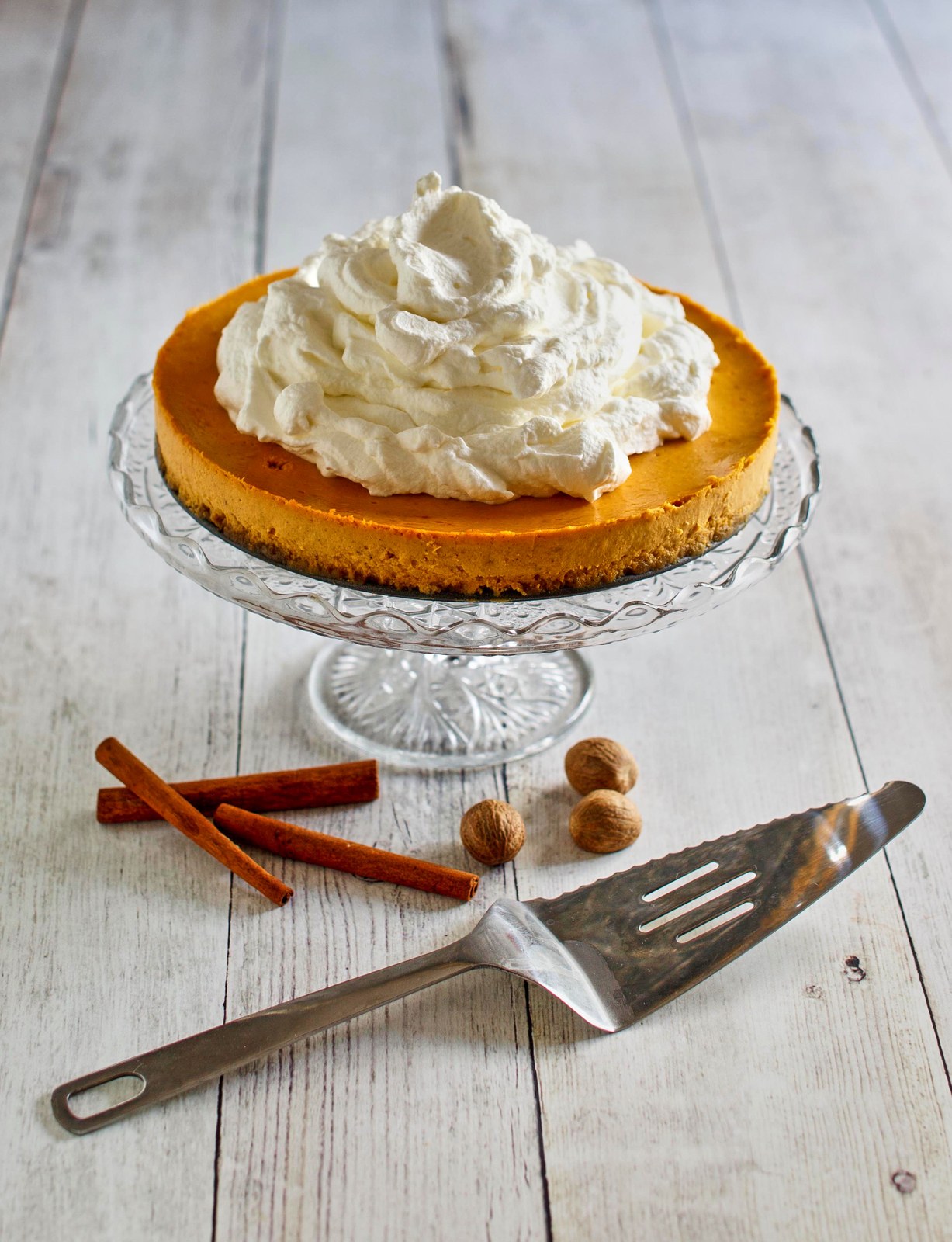
An exhausted baker, a modified recipe, a missing water bath, and one catastrophic turn of the oven dial.
You’re exhausted, but somewhere beneath the fatigue, a little kindling of motivation is still burning.
“I know! I’ll make that dessert!”
You cruise through No Ads Cooking’s latest October issue of premium recipes, and we have a winner: pumpkin cheesecake with a gingersnap crust.
Hell yes.
It’s fall. Pumpkin tastes good for approximately six weeks out of the year. LFG.
I had been dancing around making this cheesecake for almost a week, so I already had the ingredients. All I needed to do was execute.
There were warning signs.
Let’s Just Modify It
To be honest, I was already a little put off by our own recipe.
Does that ever happen to you? You prepare to deliver on your own promise, give it a healthy once-over, and realize that you may be imposing demands on other people that you would not accept for yourself?
That was how I felt about the request for 32 ounces of cream cheese.
More on that later.
Mostly, I was irritated because I had purchased two eight-ounce bricks for something like four or five dollars apiece. I was not thrilled to discover that I apparently needed twice as much.
Yep. Thirty-two ounces.
But it was nighttime, and I was motivated now—not tomorrow, not after another trip to the store. This motivation might never strike again.
So let’s modify.
Easy. Cut everything in half.
Except I didn’t want half of everything. I wanted less cream cheese.
After some finagling, I got the adjustments where I wanted them and went to work.
Then came issue number two:
Whip room-temperature cream cheese.
Ugh.
I had not taken the cream cheese out of the refrigerator. The bricks were not merely cold. They were still sitting inside the refrigerator.
But again, the motivation was happening now. No more follies. Let’s power through.
Besides, beating the cream cheese would create friction. Friction creates heat. Therefore, beating the cold cream cheese would eventually warm it up.
Right?
Right???
Locked and Loaded
Everything seemed to be going well.
Springform pan—the one that never gets used, even though I once wrote an entire article about how it can be used for everything—locked and loaded.
Can of pumpkin purée: ready.
Pricey gingersnap cookies for the crust: certifiably crumbled.
The time was nigh.
Form the crust. Prebake the crust. Mix the filling. Pour the filling over the crust.
Then:
What is a water bath?
I looked up “water bath” and decided there was absolutely no way I was dealing with that. I didn’t have the right equipment, and I now remembered seeing something about it in the instructions and thinking, I don’t know what that is, but let’s not worry about it. How hard can it be?
I’m not sure difficulty is the right way to evaluate a water bath.
It’s more of a will you or won’t you situation, mixed with an equipment-based question of can you?
Either way, we were living with the trade-off.
Forget the water bath.
We Made It
Into the oven it went.
Nice. We made it.
Now it was time to clean the kitchen.
I am a clean-while-I-cook person. Years in the kitchen have taught me that if I expect myself to clean everything at the end of a session, the odds of that happening decrease in direct proportion to the number of accumulated dishes and utensils.
If I clean as I go, the final wipe-down doesn’t feel like such a chore.
So off I went. Wash the bowls. Clean the utensils. Clear the counters. Let the cheesecake bake.
One final wipe across the counter and—
BEEEEEEEEEEEEEEEEEEP!
WTF was that?
Why does the stove say 500 degrees?
WTF is happening?
I opened the oven. Smoke was beginning to form. The top of the cheesecake already looked done.
It had been 20 minutes.
How long had this been happening? Why was it happening? This thing had already cost me $20.
Dear God, help me.
Save this cheesecake.
CSI: Kitchen
The evidence quickly revealed what had happened.
While cleaning the counter, I had accidentally hit the oven control and moved the temperature from a gentle 325-degree bake to the maximum setting of 500 degrees.
Of all the errors detected, ignored, evaded, and compromised on the way into that oven—
Now this?
We Get What We Get
At this point, we were committed. This cheesecake was getting made one way or another.
My enthusiasm, however, was crushed.
The time and money invested in this thing were real. None of this was cool.
I turned the temperature back down and decided that we would get what we get.
Honestly, it wasn’t quite as bad as it sounds. The crust burned, but the cheesecake itself mostly just cooked very quickly. It probably would have been worse if I had used the full 32 ounces of cream cheese, because then I would have needed to bake that scorched crust even longer.
But I will say this: the 32 ounces were right.
Sixteen ounces produced a thin cheesecake. When you picture cheesecake, you picture something that stands tall. If I wanted to use less cream cheese, I also needed to reduce the surface area by using a smaller pan.
The recipe was correct as written.
If I know anything about baking, it’s that you can modify it—but it is also the one area of cooking where you should probably follow the directions unless you know for a fact that something is wrong.
This was valuable information to remind myself of again after the cheesecake had already been baked at 500 degrees.
I turned off the oven, propped open the door, and let it rest.
An hour later, it went into the refrigerator.
I Still Ate That Sh!t
Another hour passed.
The question of whether the cheesecake was completely ruined began gnawing at me. I pulled it out of the refrigerator and cut myself a sliver.
I took a bite.
It tasted like a decent cheesecake with a burned crust.
There was no hiding from it. It was what it was.
Three days later, it was gone.
Burned crust and all, we still ate that sh!t.